WHMCS (Web Host Manager Complete Solution) is client management, billing, and automation software built for web hosting companies. It invoices customers, provisions hosting and domains, runs support tickets, and connects to control panels such as cPanel, Plesk, and DirectAdmin. Hosting providers use it as the operating system of the business, not as a website builder.
Operating a web hosting business is more challenging than simply making websites live. Behind every shared hosting package and domain, you purchase lies a web of invoices, support requests, client accounts, payment failures, server provisioning task and renewal reminders. For small or growing businesses, handling all of this manually is not just time-consuming; it’s a reason for errors, missed payments, and unhappy clients.
Since its launch in 2003, WHMCS has become the widely used platform for hosting automation and business management. Hosting providers, domain resellers, IT service companies, and web agencies worldwide utilize to manage daily operations. In this comprehensive guide, we will explain down everything you need to know about WHMCS, what it is, what it does, how to install it, how much it costs, and whether it’s the right choice for your business.
Key Takeaways
- WHMCS (Web Host Manager Complete Solution) is an all-in-one billing, automation, and client management platform built specifically for web hosting businesses.
- It automates invoicing, domain registration, hosting provisioning, and customer support, eliminating hours of manual work.
- WHMCS pricing starts at $34.95/month (Plus plan, up to 250 clients), with new 2026 tiers reaching up to $1,999.95/month for unlimited clients.
- It integrates with 80+ payment gateways, control panels like cPanel/Plesk, and hundreds of domain registrars.
- WHMCS is not free, but some reseller hosting providers bundle it at no extra cost.
- Licenses are priced by client count. For 2026 amounts, use the WHMCS pricing 2026 breakdown.
What does WHMCS stand for?
WHMCS stands for Web Host Manager Complete Solution.
The name originates from the early integration with the hosting stack. Web Host Manager (WHM) is the administrative interface of cPanel. WHMCS was developed to handle billing and client management alongside it. Although it continues to integrate and work with cPanel, WHMCS isn’t limited to cPanel. You can seamlessly operate it with other panels, custom provisioning or as billing only platform.
What is WHMCS?
WHMCS is a web hosting billing, automation, and client management platform that helps hosting providers manage their day-to-day operations. Staff use the admin area to manage clients, services, orders, invoices, domains, and support tickets, while customers access their accounts through the client area.
These records are managed through a central database, helping businesses keep their operations organized. WHMCS has been serving the hosting industry since 2003. Its name comes from the traditional cPanel and WHM hosting stack, but the platform is not limited to cPanel.
WHMCS is the attempt to keep those records in one place and to let software do the repetitive parts.
A typical paid hosting order can be configured to:
- Create or update the client.
- Create the order.
- Take payment through a gateway.
- Ask the server module to create the account.
- Email the login details.
- Raise the next invoice when the next due date arrives.
- Remind, suspend, or terminate if payment rules say so.
None of that is magic. It depends on products, gateways, servers, and automation settings you configure. If a module is missing or the cron is down, the same order still needs a person.
For the invoice side in more detail, see how the WHMCS billing system works.
How does WHMCS work?
Most hosts buy WHMCS for this sequence:
- The customer places an order on your site.
- WHMCS creates the order and the invoice.
- The customer pays.
- The payment gateway confirms the transaction.
- WHMCS sends a provisioning request to the connected panel or infrastructure.
- The service is created and the customer receives the details.
- WHMCS keeps billing and renewing that service until it is cancelled or terminated.
The same idea applies to domains, VPS, dedicated servers, licenses, and other recurring products. The difference is which module talks to which system.
In the usual setup WHMCS is self-hosted through which you can easily install it on a server you manage, point a URL like yourdomain.com/clients/ at it, and easily register, connect payment, and provisioning modules. For daily schedules automation tasks WHMCS relies on cron job and if the cron job stops working, important processes like payment reminders, invoice generations, and service suspensions may be delayed or fail to operate on schedule.
What is WHMCS used for?
WHMCS is a multi-purpose platform used across several critical business functions:
Billing & Invoicing Automation: WHMCS automatically generates invoices, sends payment reminders, processes recurring payments, handles overdue accounts, and supports multi-currency billing with automated tax calculations. Businesses can configure promotional discounts, pro-rated charges, and refund workflows without manual effort.
Client Management: A centralized client area lets customers view their active services, pay invoices, manage domains, open support tickets, and update account details, all from a branded self-service portal. Admins get a full dashboard of every client’s profile, order history, and account status.
Domain Registration & Management: WHMCS integrates directly with major domain registrars including GoDaddy, Namecheap, ResellerClub, Enom, and more. This enables customers to search, register, transfer, and renew domains directly from your platform, with WHMCS handling all registrar API communication automatically.
Hosting Account Provisioning: WHMCS connects with control panels like cPanel, Plesk, and DirectAdmin to automatically create, suspend, or terminate hosting accounts when a customer buys, upgrades, or cancels a plan. There is no manual server management needed.
Support Ticket System: The built-in helpdesk includes a full ticketing system organized by departments (e.g., Billing, Technical, Sales), with email piping, SLA enforcement, automated escalation rules, and an integrated knowledge base for self-service support.
Fraud Prevention: WHMCS integrates with fraud detection services like MaxMind and FraudLabs Pro to screen suspicious orders, flag high-risk transactions, and protect your business from chargebacks and fraudulent signups.
IT & MSP Services: Beyond traditional web hosting, Managed Service Providers (MSPs) use WHMCS to handle software licensing, cloud service subscriptions, IT support contracts, and recurring SaaS billing, all within the same platform.
Key WHMCS features
| Feature | Description |
| Automated Billing | Recurring invoices, payment reminders, and overdue management |
| Client Area | Branded self-service portal for customers |
| Domain Management | Registrar integration for domain registration, transfer, and renewal |
| Hosting Provisioning | Auto-create/suspend/terminate accounts on cPanel, Plesk, DirectAdmin |
| Support Ticketing | Built-in helpdesk with departments, SLA rules, and knowledge base |
| Fraud Detection | MaxMind & FraudLabs Pro integration |
| Multi-Currency | Global billing with automated exchange rate updates |
| Tax Management | Regional tax rules, VAT compliance, and Peppol e-invoicing |
| Payment Gateways | 80+ gateways including Stripe, PayPal, Authorize.Net, Razorpay |
| API & Modules | Extensible via REST API, custom modules, and hooks |
| Reporting & Analytics | Revenue reports, client statistics, and business dashboards |
| Email Templates | Customizable transactional email system with automation |
| AI Domain Suggestions | WHMCS 9.0 introduces AI-powered domain name recommendations |
| Peppol E-Invoicing | Compliance-ready invoicing for UK, Australia, Singapore & more |
WHMCS 9 also modernizes checkout and adds AI domain suggestions, Peppol e-invoicing, and a Buy Flow API for developers. Treat those as version specific. Check out the release notes for the version you run before you promise them on a sales page.
WHMCS client area
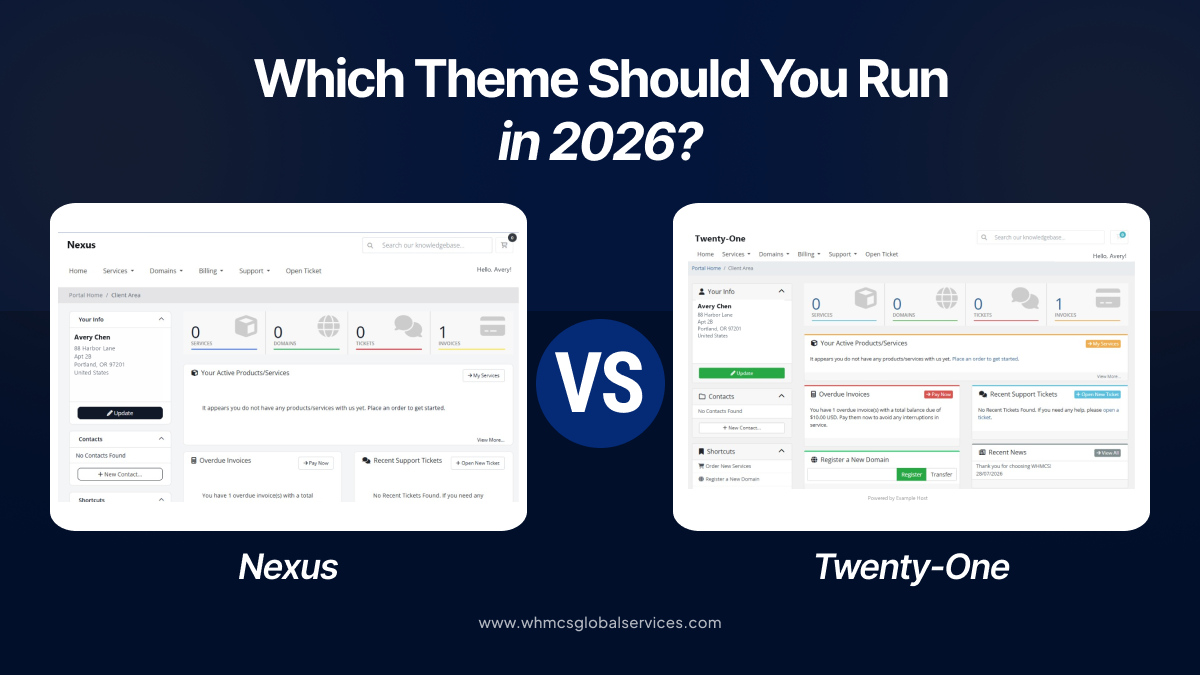
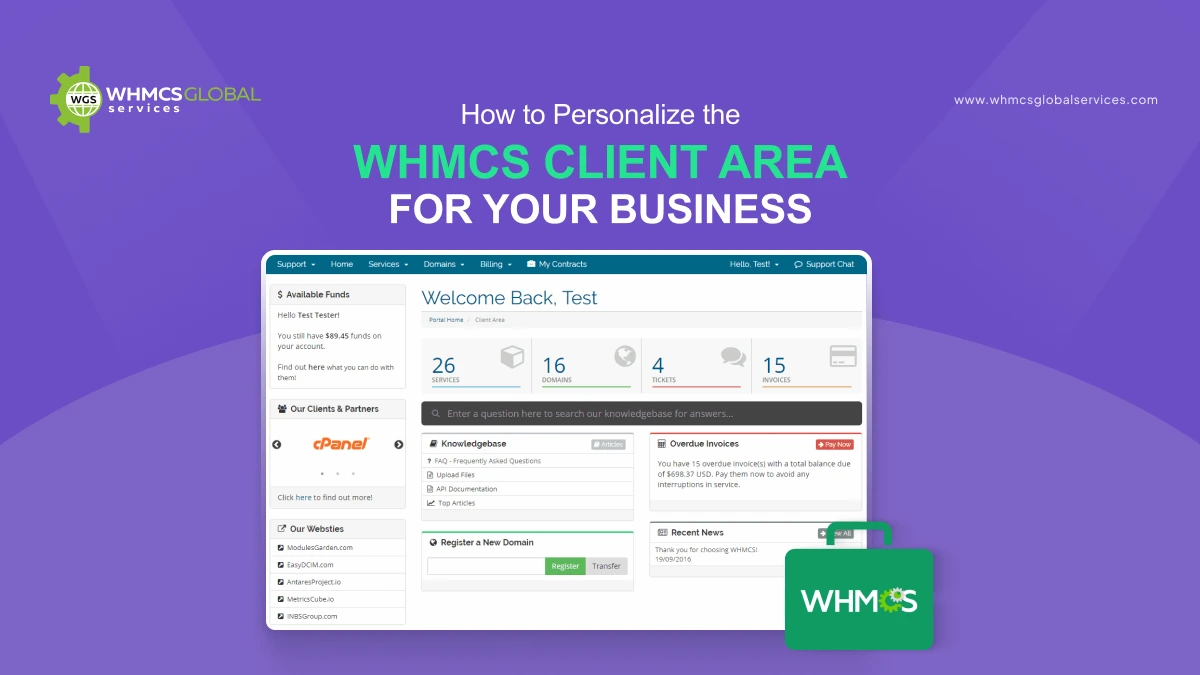
WHMCS clients is the first impressions for the customers after they sign in. Based on your process setup, clients can access services, manage domains, pay invoices, open tickets, easily update account details, download files, and read knowledge base articles. The default WHMCS client area is functional, but its design may not always match the branding of the main website.
Many hosting providers use a custom-client area theme to create a more consistent experience with their website. The theme changes the layout, navigation, and visual branding while keeping the underlying WHMCS management and billing functions unchanged.
What are WHMCS modules?
WHMCS modules allow you to connect WHMCS with other tools your hosting business uses like control panels, hypervisors, domain registrars, payment gateways, accounting software, and custom APIs.
For instance, if you use Proxmox to operate VPS servers, WHMCS can manage and handle the custom order and payment, while a Proxmox module can automatically create the VPS once the payment is confirmed. An accounting module is what copies those invoices into the bookkeeping tool. Without the module, staff do that work by hand.
Examples of WHMCS modules
The list below is not the full marketplace. It is the set of extensions hosts ask about when they outgrow shared hosting and a single cPanel server.
Infrastructure and VPS
VMware WHMCS Module: The VMware WHMCS Module is built for hosting providers offering VMware-based VPS and dedicated server solutions. This module automates server provisioning, account management, and service handling directly from WHMCS, reducing manual administrative work and improving operational efficiency.
Proxmox VPS WHMCS module: The Proxmox VPS WHMCS module integrates Proxmox VE with WHMCS, allowing hosting providers to offer KVM and LXC VPS services through WHMCS. Depending on the enabled features, customers can manage their VPS with options such as start/stop controls, console access, backups, and snapshots.
AWS Lightsail WHMCS module: The AWS Lightsail WHMCS module connects Amazon lightsail instances with WHMCS products, making it easier to offer and manage Lightsail services through WHMCS. You sell cloud VPS under your own brand. WHMCS still takes the order and the invoice. AWS still runs the instance.
OVH / SoYouStart WHMCS Module: For businesses using OVH or SoYouStart infrastructure, the OVH & SoYouStart WHMCS Module enables automated server provisioning and management directly from WHMCS. It allows hosting companies to integrate OVH and SoYouStart dedicated servers and VPS services into their billing and automation workflows efficiently.
Hosting and cloud services
Cloudflare WHMCS Module: The Cloudflare WHMCS Module helps hosting providers integrate Cloudflare services into WHMCS, allowing customers to manage DNS, CDN, security, and performance features directly from the client area. This module enhances automation while improving website security and performance management for end users.
NextCloud WHMCS Module: For cloud storage and collaboration services, the NextCloud WHMCS Module automates the provisioning and management of Nextcloud accounts through WHMCS. It simplifies account deployment, user management, and hosting automation for businesses offering private cloud storage solutions.
iRedMail WHMCS module: The iRedMail WHMCS Module connect iRedMail mail services with WHMCS, allowing providers to sell and manage mailbox packages through WHMCS. When a customer places an order, the module can create the mailbox account and handle recurring, while iRedMail continues to manage the email service on the mail server.
Business and accounting
Indian GST WHMCS module: The Indian GST WHMCS Module extends WHMCS billing with GSTIN details, HSN/SAC codes, GST calculations on invoices, and GSTR-style reporting. It adds GST-specific features that are not fully covered by WHMCS’s standard tax settings.
Spanish Veri*Factu WHMCS module: The Spanish Fiscal E-Invoicing WHMCS module connects WHMCS invoices to Spain’s Veri*Factu / AEAT invoicing requirements: invoice records, verification data, submission status, and related reporting. Tax law is local. Confirm the module against current AEAT rules before you rely on it.
Zoho Books WHMCS module The Zoho Books WHMCS module syncs clients, invoices, and related records so accounting does not start from a CSV export every month. WHMCS remains the billing system. Zoho Books remains the ledger.
Authentication and communication
Passkey authentication WHMCS module: The Passkey WHMCS module adds passwordless login with device biometrics or security keys for the client area, and for admin where configured. It sits beside existing passwords. It does not replace WHMCS user records.
WhatsApp notification WHMCS module: The WhatsApp notification module sends order, invoice, payment, and ticket events to WhatsApp. Email still goes out. WhatsApp is an extra channel for hosts whose customers actually read it.
Module vs theme vs hook
- Module: new automation or a connection to another system (servers, payments, tax, accounting).
- Theme/template: how the client area or hosting website looks. It does not replace the billing engine.
- Order form: the WHMCS cart and checkout pages. Separate from the client area theme.
- Hook: a small PHP callback on a WHMCS event, without editing core files. See the WHMCS hooks list.
- Custom development: when no off-the-shelf module covers the workflow.
What are WHMCS themes?
WHMCS themes are templates that control the look and layout of the WHMCS client portal: the pages customers see when they log in, place an order, pay an invoice, or manage a service. Some packages also include a public hosting website in front of WHMCS. A theme changes branding, navigation, forms, typography, and mobile layout. It does not change how invoices are calculated or how a server is provisioned.
The point of a theme is a client area (and often a storefront) that matches the company site, instead of the default WHMCS skin. Full catalogs live on the hubs. The product pages below are the individual themes:
HostX WHMCS Theme: The HostX WHMCS Theme is a complete web hosting website solution that combines a front-end website, WHMCS client area, and custom order forms into a single package. HostX is highly customizable and includes advanced features like page builders, mega menus, SEO management, dynamic pricing tables, and responsive layouts, making it ideal for hosting providers, VPN companies, domain registrars, and cloud service businesses.
CloudX WHMCS Theme: For businesses looking for a modern hosting and client area experience, the CloudX WHMCS Theme provides a responsive and fully customizable interface with multiple layouts, multilingual support, RTL compatibility, and flexible menu customization. CloudX is designed to deliver a smooth customer experience across desktops, tablets, and mobile devices while helping hosting companies establish a professional online presence.
ClientX WHMCS Theme: The ClientX Client Area Template focuses on redesigning the WHMCS client area with a cleaner and more engaging interface. ClientX enhances usability through improved UI/UX elements, flexible branding options, and responsive layouts that create a more professional customer portal experience for hosting businesses.
TwentyX WHMCS Theme: Another powerful client area solution is the TwentyX Client Area Template, a child theme developed specifically for the WHMCS Twenty-One system theme. TwentyX includes more than 70 pre-designed client area pages and responsive layouts that help businesses quickly transform their WHMCS portal without extensive development work. It is especially useful for companies wanting a modern and professional client area while retaining compatibility with WHMCS updates.
AdminX WHMCS Theme: To improve backend administration and workflow efficiency, the WHMCS AdminX Theme provides a redesigned WHMCS admin interface with simplified navigation and enhanced usability. AdminX helps administrators access commonly used sections faster and streamlines day-to-day management operations within the WHMCS admin panel.
WHMCS order forms
WHMCS order forms (cart templates) are the checkout pages: product, domain, configurable options, account details, and payment. They are not the client area theme and not a provisioning module. You can run HostX or ClientX on the portal and a different order form on the cart. The billing engine stays WHMCS either way.
The catalog is on WHMCS orderform templates.
WHMCS One Step Checkout order form: The WHMCS One Step Checkout order form puts the default multi-step cart onto one page. The customer sees the plan, configurable options, promo code, payment method, and order summary without bouncing through several WHMCS cart screens.
It supports country-based payment gateways, GeoIP currency, a mobile mini cart, addons, and more than one language or currency. It installs a WHMCS order form (files in the order-form folder, then activate). It does not replace client-area pages. It works when the public site is WordPress or HTML, and with client-area skins such as Six, HostX, ClientX, and Lagom.
VueJS + WHMCS One Step Checkout order form: The VueJs+WHMCS one Step Checkout order form offers more fast, single-page checkout experience using Vue.js, allowing cart updates without reloading the entire page. It can be used for hosting, VPN,domains, SSL, VoIP, VPS, and other WHMCS-based services.
The order form supports gateway, product, and configurable option icons, along with location-based currency detection and multiple languages. Hosts can also customize the checkout colors and layout through the product settings.
WHMCS pricing
WHMCS is a commercial software. There is no free plan. Licenses are monthly and scale by the number of active clients.
In 2026, Plus is $34.95/month for up to 250 clients. Professional is $54.95/month for up to 500. Business plans start at $84.95/month. Amounts change. Confirm on WHMCS.com before you buy it.
The full 2025 vs 2026 table, client limits, and what changes sit on the WHMCS pricing 2026 breakdown. This page is the definition. That page is the price list.
How to install WHMCS
Prerequisites
Before installing WHMCS, ensure your server meets these requirements:
- PHP: 8.1 or higher (check official WHMCS docs for latest).
- MySQL: 5.7+ or MariaDB 10.3+.
- ionCube Loader: Required (encrypts WHMCS source files).
- Extensions: soap, XML-RPC, curl, gd, mbstring, imap, zip.
- PHP Memory Limit: Minimum 512MB.
- Disk Space: At least 500MB free.
Step 1: Purchase a WHMCS License
Visit whmcs.com and select the appropriate plan based on your expected client count. You will receive a license key after purchase. Some reseller hosting providers (like SkyNetHosting.net) include WHMCS free with their reseller plans.
Step 2: Download WHMCS
Log into the WHMCS client area and download the latest stable release .zip file. Always download from the official WHMCS website to ensure you have clean, untampered files.
Step 3: Create a MySQL Database
In your cPanel or server panel:
- 1. Navigate to MySQL Database Wizard.
- 2. Create a new database (e.g., youruser_whmcs).
- 3. Create a dedicated database user with a strong password.
- 4. Assign full privileges: SELECT, INSERT, UPDATE, DELETE, LOCK TABLES, ALTER, CREATE, DROP, INDEX.
Step 4: Install ionCube Loader
WHMCS source files are encrypted using ionCube. If your hosting already has cPanel, ionCube is likely pre-installed. Verify by checking your phpinfo() output. If not, install it via your server’s PHP configuration or ask your host.
Step 5: Upload WHMCS Files
- 1. Unzip the downloaded WHMCS package on your computer.
- 2. Rename configuration.php.new to configuration.php.
- 3. Upload the entire whmcs folder to your server using an FTP client (e.g., FileZilla) or cPanel File Manager.
- 4. Upload in binary mode if you encounter issues.
Step 6: Run the Web Installer
In your browser, navigate to: http://yourdomain.com/whmcs/install/install.php.
Follow the on-screen wizard:
- 1. Accept the End User License Agreement (EULA).
- 2. Enter your MySQL database credentials.
- 3. Enter your WHMCS license key.
- 4. Set file permissions as instructed.
- 5. Create your primary admin account.
Step 7: Post-Installation Security Steps
After installation completes:
- 1. Delete the /install/ folder immediately, WHMCS will not function properly until this is removed.
- 2. Set configuration.php to permission 644.
- 3. Secure sensitive directories: attachments, downloads, templates_c.
- 4. Enable HTTPS and redirect all HTTP traffic.
- 5. Move the admin directory to a custom URL for security.
- 5. Set up a cron job for automated tasks (renewals, invoices, etc.): php -q /path/to/whmcs/crons/cron.php.
Step 8: Run the Getting Started Wizard
Log into your WHMCS admin area and complete the Getting Started Wizard, which guides you through:
- 1. Company information, logo, and address.
- 2. Payment gateway setup (PayPal, Stripe, bank transfers).
- 3. Domain registrar configuration.
- 4. First cPanel/Plesk server connection.
- 5. Email template configuration.
- 5. Support ticket department setup.
Official Documentation: WHMCS documentation
Who uses WHMCS?
WHMCS is used by businesses that invoice a recurring service and need a client login:
- Web hosting companies: shared, reseller, VPS, dedicated, domains, tickets.
- Hosting resellers: sell someone else’s servers, keep billing and support in-house.
- VPS providers: connect WHMCS to Proxmox, VMware, cloud APIs, or custom provisioners.
- Dedicated server providers: orders, deposits, monthly billing, and reinstall workflows.
- Domain resellers: registrar APIs for search, register, transfer, and renew.
- Cloud providers: sell instances under their own brand, bill in WHMCS.
- Managed service providers: retainers, licenses, and support contracts with a due date.
- Digital agencies: hosting and care plans for clients who should not live in a spreadsheet.
It is a poor fit if you need a general CRM, a WordPress site builder, or a one-time project shop with no renewals.
Is WHMCS right for your business?
WHMCS is worth it when you sell recurring services and you are tired of creating accounts and invoices by hand. It is a strong fit if:
- You run or plan to run a hosting company or reseller business.
- You need automated recurring invoices instead of a spreadsheet.
- You want a client login, tickets, and billing in one place.
- You are an agency billing care plans or hosting for several clients.
- You are an MSP selling licenses, cloud, or support contracts on a cycle.
It is less of a fit if you have a handful of clients, no one to maintain a PHP app, or a product that is nothing like hosting. Look at client volume, which integrations you must have, who will patch the server, and whether you can live with a commercial license. The cheapest billing tool is still expensive if staff re-key every order.
WHMCS alternatives
WHMCS is not the only hosting billing platform. Common names in the same conversation are FOSSBilling, Blesta, HostBill, WISECP, and Paymenter. They differ on license cost, how open the code is, modules, and how painful a migration will be.
Compare them on the WHMCS alternatives page. For a two-way comparison, see WHMCS vs Blesta. Do not pick a platform from a feature grid alone. Check the provisioner you actually run and who will maintain it in two years.
Can WHMCS be customized?
Yes. The supported ways are modules, hooks, the API, themes, and templates. Developers build custom gateways and provisioners when the marketplace does not have the system you run.
That flexibility is also the maintenance cost. Custom PHP that edits core files will break on upgrade. Hooks and modules age better. If you need WHMCS to talk to a CRM, an internal portal, or a custom hypervisor, plan for development time, not only the license invoice.
WHMCS API and integrations
The API is how another application creates clients, reads invoices, or triggers actions without a person clicking around the admin area. Typical uses are accounting sync, custom storefronts, provisioning, and internal reports.
Modules still do most day-to-day connections. Use the API when you are building your own glue, not as a replacement for a server module that already exists.
WHMCS automation and cron jobs
The daily cron is not optional. It is how WHMCS generates invoices, sends reminders, applies suspensions, processes domain reminders, and runs some module tasks. Set it when you install. Check it when “WHMCS stopped billing.”
Automation settings then decide how aggressive those jobs are: how many days before due the invoice goes out, when a reminder fires, and when an unpaid service suspends. Get those wrong and you either suspend good customers or carry dead accounts for months.
Advantages of using WHMCS
- One record for the client, the service, the invoice, and the ticket.
- Automation for the order-to-account loop that hosts repeat all day.
- A large integration list for panels, registrars, gateways, and third-party modules.
- Room to customize with modules, hooks, APIs, and themes.
- A client area so customers can pay and manage services without a phone call.
- Recurring billing as a first-class workflow, not a plugin afterthought.
Things to consider before using WHMCS
- License cost. Paid software, priced by clients, and the 2026 list is higher than 2025. Budget it as an operating cost.
- You run the server. Updates, HTTPS, backups, and PHP versions are yours.
- Third-party modules. Each one is another thing to test on upgrade. Buy from people who still ship updates.
- Customization skill. Serious changes need PHP, Smarty, hooks, or a developer.
- Upgrade discipline. WHMCS, ionCube, PHP, themes, and modules have to move together.
| Fits well | Friction |
| Hosting and other recurring IT services | No free plan; Plus starts at $34.95/month |
| Wide marketplace of gateways, registrars, and modules | Learning curve if you have never run a billing app |
| Hooks, API, and custom provisioners | Heavy custom work is PHP, not a page builder |
| Fraud tools and regular product patches | Self-hosted: you patch the box |
| Multi-currency and tax rules for international sales | Lifetime licenses are gone; you subscribe |
Conclusion
WHMCS remains the gold standard for web hosting automation, and for good reason. No other platform offers the same depth of integration, the breadth of the module ecosystem, or the reliability of two decades of active development. From automating your first invoice to managing 10,000+ clients across multiple servers and registrars, WHMCS scales with you.
That said, WHMCS is not a one-size-fits-all solution. The 2026 pricing changes have created challenges for smaller businesses and solo resellers, pushing some toward open-source alternatives like FOSSBilling or budget-tier competitors. If you are just starting out, evaluate your projected client growth against the plan tiers, the licensing cost is justified only when WHMCS’s automation saves you more time (and money) than it costs.
For established hosting businesses, IT service providers, and ambitious resellers, WHMCS continues to be the definitive choice. With WHMCS 9.0 bringing AI-powered domain suggestions, modernized checkout flows, Peppol e-invoicing, and a new developer-ready Buy Flow API, the platform is clearly investing in the future, not resting on its reputation.